To lose fat while keeping your muscle, aim for about 1.8–2.4 g of protein per kg of body weight per day (0.8–1.1 g per lb). That's a bit more than the 1.6–2.2 g/kg usually recommended for building muscle, because muscle is easier to lose in a calorie deficit. If you have a lot of fat to lose, base the number on your goal weight instead of your current weight.
Protein for fat loss by body weight
| Body weight | Minimum (1.6 g/kg) | Target (1.8–2.4 g/kg) |
|---|---|---|
| 130 lb (59 kg) | 95 g | 105–140 g |
| 150 lb (68 kg) | 110 g | 120–165 g |
| 170 lb (77 kg) | 125 g | 140–185 g |
| 190 lb (86 kg) | 140 g | 155–205 g |
| 210 lb (95 kg) | 150 g | 170–230 g |
| 230 lb (104 kg) | 165 g | 190–250 g |
Rounded to the nearest 5 g. Our protein calculator uses 2.0–2.4 g/kg for the "lose fat" goal, the middle-to-top of this range, which suits most people who lift.
Why you need more protein when dieting
In a calorie deficit, your body is short on energy and more willing to break down muscle. Eating more protein, together with strength training, is the best way to tell it to burn fat instead. Reviews of dieting lifters suggest that higher intakes are most helpful for people who are already lean and in a large or long deficit. A 2014 review recommended up to 2.3–3.1 g per kg of lean body mass for lean lifters getting ready for competition, and the International Society of Sports Nutrition gives a similar range for people dieting hard.
Protein helps in two more ways:
- It keeps you full. Protein-rich meals reduce hunger more than the same calories from carbs or fat.
- It costs more to digest. Around 20–30% of the calories in protein are used just to process it, compared with much less for carbs and fat.
Who should aim higher or lower
| Situation | Suggested intake |
|---|---|
| Lean lifter, aggressive cut | 2.2–2.4 g/kg (top of the range) |
| Most people losing fat and lifting | 1.8–2.2 g/kg |
| Lots of fat to lose | 1.8–2.2 g/kg of goal weight |
| Not lifting at all | At least 1.2–1.6 g/kg, and start lifting |
Easy ways to hit your target
- Build each meal around protein: 30–50 g per meal, 3–4 meals a day. See protein per meal.
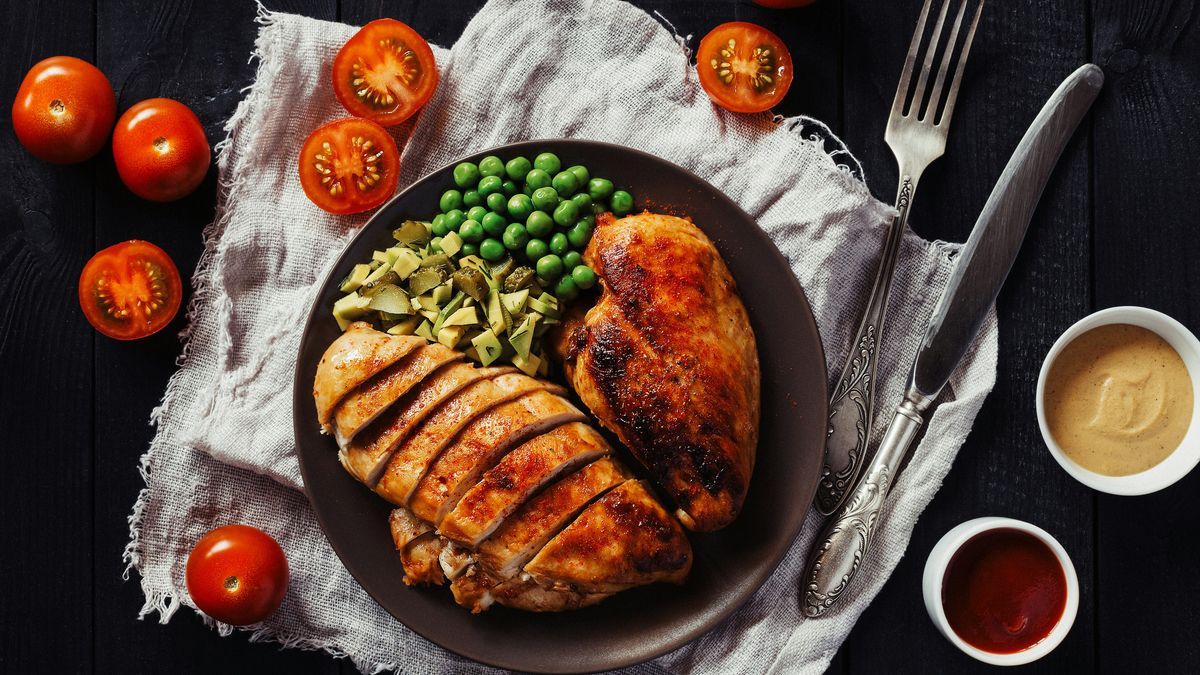
- Pick lean sources that give lots of protein for few calories: chicken breast, white fish, egg whites, Greek yogurt, cottage cheese, tuna, lean beef, tofu.
- Use a shake when it's convenient. One scoop of whey has about 25 g of protein for roughly 120 kcal.
- Plan the day backwards. If dinner is protein-light, make breakfast and lunch protein-heavy.
Protein alone won't do it
Protein protects muscle, but you still need a calorie deficit to lose fat and strength training to keep muscle. Aim to lose about 0.5–1% of your body weight per week; see how fast you can lose fat and how to cut without losing muscle. Get your calories from our TDEE & macro calculator.
Frequently asked questions
Can eating too much protein stop fat loss?
Only if it pushes you out of a calorie deficit. Protein still has calories, about 4 per gram.
Is 1 g of protein per pound too much?
No. For a lean person in a deficit, it's a sensible upper target. Most people do well with a bit less.
Is a high-protein diet safe?
For healthy adults, research hasn't found problems at these intakes. If you have kidney disease or another medical condition, talk to your doctor first.
Sources
- Helms, E. R., Zinn, C., Rowlands, D. S., & Brown, S. R. (2014). A systematic review of dietary protein during caloric restriction in resistance trained lean athletes: a case for higher intakes. International Journal of Sport Nutrition and Exercise Metabolism, 24(2), 127–138.
- Jäger, R., et al. (2017). International Society of Sports Nutrition position stand: protein and exercise. Journal of the International Society of Sports Nutrition, 14, 20.
- Morton, R. W., et al. (2018). A systematic review, meta-analysis and meta-regression of the effect of protein supplementation on resistance training-induced gains in muscle mass and strength in healthy adults. British Journal of Sports Medicine, 52(6), 376–384.
- Westerterp, K. R. (2004). Diet induced thermogenesis. Nutrition & Metabolism, 1, 5.