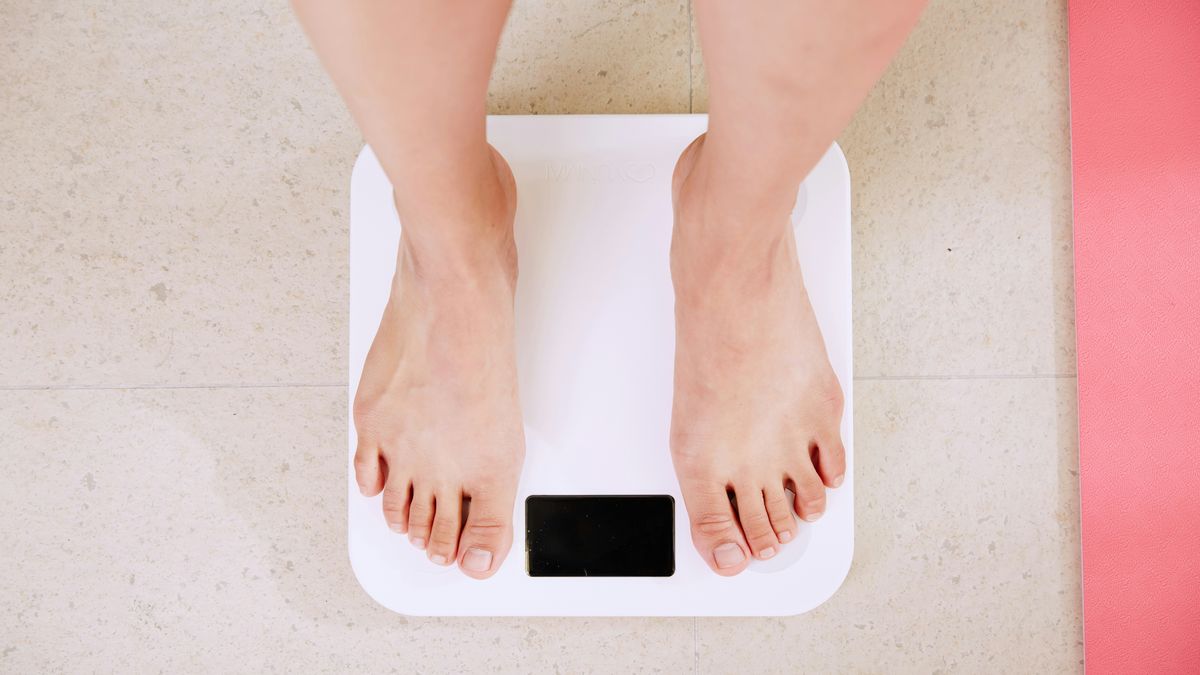
A realistic and muscle-friendly rate of fat loss is about 0.5–1% of your body weight per week. For a 180 lb (82 kg) person, that's roughly 0.9–1.8 lb (0.4–0.8 kg) a week. Leaner people should aim for the lower end; people with more fat to lose can go faster at first.
Weekly fat-loss targets by body weight
Based on 0.5–1% of body weight per week.
| Body weight | Per week (lb) | Per week (kg) |
|---|---|---|
| 140 lb (64 kg) | 0.7–1.4 lb | 0.32–0.64 kg |
| 160 lb (73 kg) | 0.8–1.6 lb | 0.36–0.73 kg |
| 180 lb (82 kg) | 0.9–1.8 lb | 0.41–0.82 kg |
| 200 lb (91 kg) | 1.0–2.0 lb | 0.45–0.91 kg |
| 220 lb (100 kg) | 1.1–2.2 lb | 0.50–1.00 kg |
| 250 lb (113 kg) | 1.2–2.5 lb | 0.57–1.13 kg |
Why faster isn't better
A 2014 review of dieting strategies for lifters recommended losing about 0.5–1% of body weight per week to keep as much muscle as possible. Go much faster and a bigger share of the weight you lose can come from muscle instead of fat, especially if you're already fairly lean. In one study, people on the same diet who slept 5.5 hours instead of 8.5 lost the same weight, but much less of it was fat. Speed and stress both push in the wrong direction.
Very aggressive diets also make you hungry, tired and grumpy, your training suffers, and most people can't keep them up. A slower diet you finish beats a fast one you quit in week three.
How big should your calorie deficit be?
A pound of body fat stores roughly 3,500 kcal, so a daily deficit of about 500 kcal is the classic starting point for 1 lb (0.45 kg) a week. That rule is an approximation: research by Kevin Hall and colleagues showed that weight loss slows over time as your body gets smaller and adapts. Use it to start, then adjust based on what the scale actually does.
| Daily deficit | Approx. loss per week | Good for |
|---|---|---|
| 250–300 kcal | 0.5 lb (0.25 kg) | Lean lifters, slow and steady cuts |
| 500 kcal | 1 lb (0.45 kg) | Most people |
| 750–1,000 kcal | 1.5–2 lb (0.7–0.9 kg) | People with a lot of weight to lose, short phases |
Find your starting point with our TDEE & macro calculator.
What to expect week by week
- Week 1–2: often a quick drop of 2–5 lb. Much of it is water and food in your gut, not fat. Enjoy it, but don't expect it to continue.
- Week 3 onward: the real fat-loss rate shows up. Compare weekly averages, not single days.
- After a few months: loss slows as you get lighter. Recalculate your calories or add a bit of activity.
How to keep your muscle while you lose fat
- Keep lifting heavy. Training is the signal that tells your body to keep muscle.
- Eat plenty of protein: about 1.6–2.2 g per kg of body weight. See our protein guide.
- Sleep 7–9 hours. Less sleep means more muscle loss, as the study above showed.
- Don't drop calories too far. If your lifts fall fast, your deficit is probably too big.
More detail in how to cut without losing muscle.
How to track progress properly
Weigh yourself first thing in the morning, after the bathroom, 3–7 times a week, and look at the weekly average. Daily weight can swing 1–4 lb from salt, carbs, water and stress. Add a waist measurement every two weeks: if your weight is flat but your waist is shrinking, it's working. Our body fat calculator uses the same measurements.
Frequently asked questions
Is losing 2 lb a week too fast?
For people with a lot of weight to lose, it can be fine for a while. For leaner people, it's usually too fast to keep muscle.
Why did I gain weight after a hard workout?
Training causes temporary water retention in muscles while they recover. It's not fat and usually goes away within days.
How long should a cut last?
Usually 8–16 weeks. After that, a few weeks at maintenance calories makes the next phase easier.
Sources
- Helms, E. R., Aragon, A. A., & Fitschen, P. J. (2014). Evidence-based recommendations for natural bodybuilding contest preparation: nutrition and supplementation. Journal of the International Society of Sports Nutrition, 11, 20.
- Hall, K. D. (2008). What is the required energy deficit per unit weight loss? International Journal of Obesity, 32(3), 573–576.
- Nedeltcheva, A. V., et al. (2010). Insufficient sleep undermines dietary efforts to reduce adiposity. Annals of Internal Medicine, 153(7), 435–441.