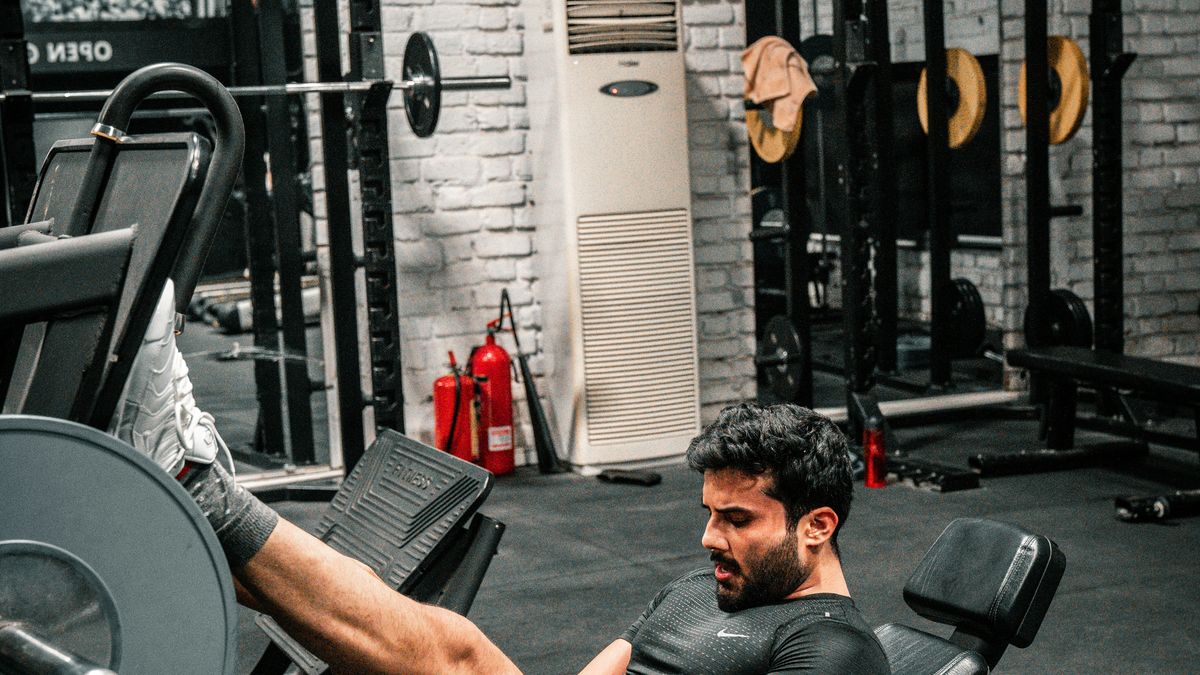
An empty plate-loaded leg press sled usually weighs somewhere between 75 and 250 lb (35–115 kg), depending on the brand and model. Many common 45-degree leg presses in commercial gyms have sleds of roughly 100–120 lb. Some brands print the "starting weight" on a sticker; most don't.
But the sled weight is only half the story. Because the sled moves up a slope, you don't push the full weight on it. And that's where leg press numbers get fun.
Why the leg press feels lighter than the plates say
On a 45-degree leg press, the sled travels up rails angled at 45 degrees. Only part of the load works against you along that slope; the rest is held up by the rails. Physics puts that share at about 71% (the sine of 45 degrees), and the machine's rollers reduce it a little further through friction.
In plain English: on a 45-degree leg press you push roughly 70% of the total loaded weight, not 100%. On a horizontal seated leg press with a weight stack, the numbers work differently, because those machines use cables and pulleys instead of a sloped sled.
| Plates loaded | Plates + 100 lb sled | Resistance along the rails (45°) |
|---|---|---|
| 0 × 45 lb | 100 lb | ~70 lb |
| 2 × 45 lb | 190 lb | ~135 lb |
| 4 × 45 lb | 280 lb | ~200 lb |
| 6 × 45 lb | 370 lb | ~260 lb |
| 8 × 45 lb | 460 lb | ~325 lb |
| 10 × 45 lb | 550 lb | ~390 lb |
Estimates for a 45-degree machine with a 100 lb sled, before friction. Real machines vary.
Leg press machine types
| Machine | How it's loaded | What the number means |
|---|---|---|
| 45-degree plate-loaded leg press | Plates on a sled that slides up rails | About 70% of plates + sled, minus friction |
| Horizontal (seated) leg press | Weight stack with a pin | Depends on the machine's pulley ratio; numbers aren't comparable between brands |
| Vertical leg press | Plates on a platform above you | Close to the full load, so numbers are much lower |
| Hack squat | Plates on a sled, often at 45 degrees | Similar maths to the 45-degree leg press |
How to find your leg press starting weight
- Check the frame for a sticker that lists the sled weight or "starting resistance".
- Look up the model. The brand and model name are usually on the frame; the manual lists the sled weight.
- Ask the staff. If they don't know, don't guess a number that flatters you.
How to log the leg press honestly
Pick one method and stick with it:
- Plates only. The simplest option. Log the plates you loaded, for example "4 plates a side". Great for tracking your own progress on the same machine.
- Plates + sled. More complete, if you know the sled weight.
Whatever you choose, don't compare leg press numbers with squat numbers, and don't compare them between machines. A different brand, angle or sled weight can change the feel by a lot. Leg press numbers are for you versus you.
Is a big leg press impressive?
It's impressive the way a long drive at the driving range is impressive: it's real, but it's not the same as playing a round. Because of the angle, the shorter range of motion many people use and the support from the backrest, most lifters can leg press two to three times what they squat. That's not a problem. The leg press is a fantastic way to train your quads hard with less fatigue and lower back strain. Just keep your squat and your leg press in separate mental boxes.
Leg press tips
- Go deep enough that your thighs come close to your chest without your lower back lifting off the pad.
- Don't lock out hard at the top. Keep a soft bend in your knees.
- Feet higher on the platform shifts work to the glutes and hamstrings; lower shifts it to the quads.
- Use the safety stops. They're there so a failed rep stays a funny story.
Frequently asked questions
Does the leg press sled count as weight?
Yes, it's part of what you're pushing. Whether you log it is up to you; just be consistent.
How much of the weight do you push on a 45-degree leg press?
Roughly 70% of the total loaded weight, a bit less once friction is included.
Why can I leg press so much more than I squat?
The angle reduces the effective load, the range of motion is often shorter, and the backrest removes the need to balance and brace a bar on your back.
Is the leg press as good as squats?
For building the quads, it's an excellent option. For strength in the squat itself and full-body coordination, nothing replaces squatting.
Sources
- Basic mechanics of inclined planes: the load component along a slope equals weight × sine of the incline angle (sin 45° ≈ 0.71).
- American College of Sports Medicine (2009). Progression models in resistance training for healthy adults. Medicine & Science in Sports & Exercise, 41(3), 687–708.