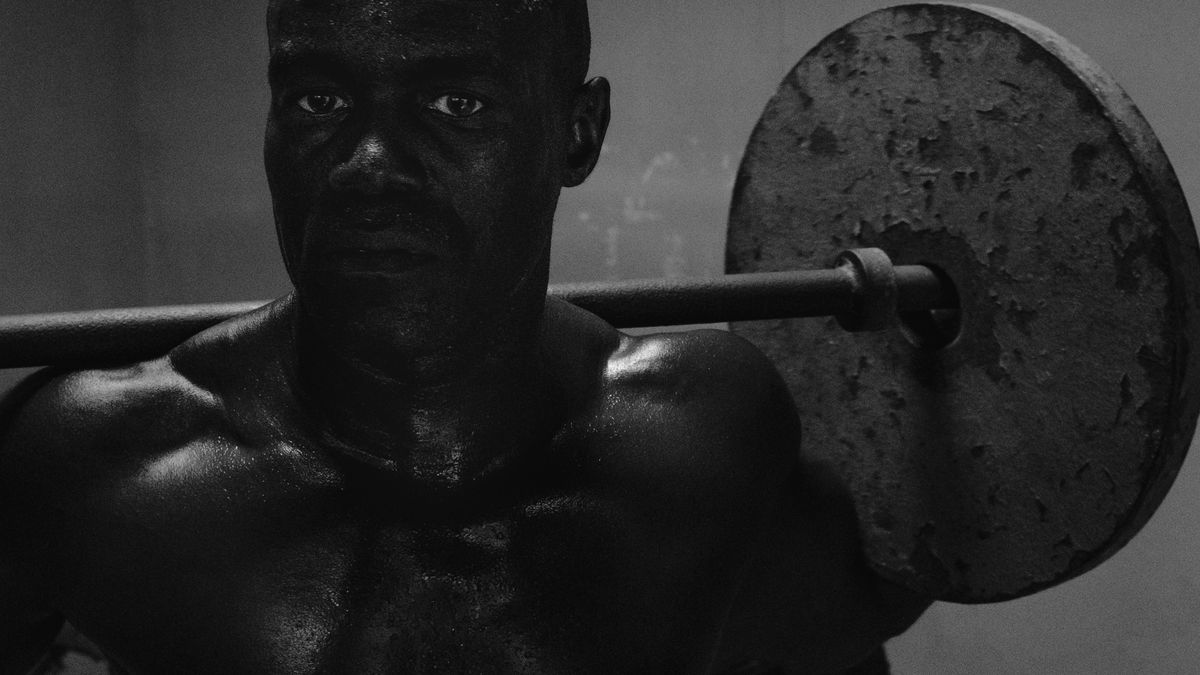
A man who has trained consistently for a year or two can typically strict press about 0.8× his body weight, and a woman about 0.5×. Beginners often start between a third and a half of their body weight (men) or a fifth to a third (women). Pressing your own body weight overhead is an advanced milestone for men and elite territory for women.
If those numbers look low compared with your bench, that's normal. You're pressing a bar over your head with your shoulders and triceps, standing up, with nothing to push against. Gravity is not on your side here.
What counts as an overhead press here
These standards are for a strict standing barbell press: bar from the front of the shoulders to locked out overhead, with no leg drive and no excessive lean back. Push presses, seated presses, dumbbell presses and the Smith machine are all different lifts. Great lifts, but different.
Average overhead press for men
One-rep max in pounds, rounded to the nearest 5 lb. Based on 0.35×, 0.55×, 0.8×, 1.1× and 1.4× body weight.
| Body weight | Beginner | Novice | Intermediate | Advanced | Elite |
|---|---|---|---|---|---|
| 130 lb (59 kg) | 45 | 70 | 105 | 145 | 180 |
| 150 lb (68 kg) | 50 | 80 | 120 | 165 | 210 |
| 170 lb (77 kg) | 60 | 95 | 135 | 185 | 240 |
| 190 lb (86 kg) | 65 | 105 | 150 | 210 | 265 |
| 210 lb (95 kg) | 75 | 115 | 170 | 230 | 295 |
| 230 lb (104 kg) | 80 | 125 | 185 | 255 | 320 |
| 250 lb (113 kg) | 90 | 140 | 200 | 275 | 350 |
Average overhead press for women
One-rep max in pounds, rounded to the nearest 5 lb. Based on 0.2×, 0.35×, 0.5×, 0.75× and 1× body weight.
| Body weight | Beginner | Novice | Intermediate | Advanced | Elite |
|---|---|---|---|---|---|
| 100 lb (45 kg) | 20 | 35 | 50 | 75 | 100 |
| 120 lb (54 kg) | 25 | 40 | 60 | 90 | 120 |
| 140 lb (64 kg) | 30 | 50 | 70 | 105 | 140 |
| 160 lb (73 kg) | 30 | 55 | 80 | 120 | 160 |
| 180 lb (82 kg) | 35 | 65 | 90 | 135 | 180 |
| 200 lb (91 kg) | 40 | 70 | 100 | 150 | 200 |
Overhead press standards in kilograms
Men (rounded to the nearest 2.5 kg):
| Body weight | Beginner | Novice | Intermediate | Advanced | Elite |
|---|---|---|---|---|---|
| 60 kg (132 lb) | 20 | 32.5 | 47.5 | 65 | 85 |
| 70 kg (154 lb) | 25 | 37.5 | 55 | 77.5 | 97.5 |
| 80 kg (176 lb) | 27.5 | 45 | 65 | 87.5 | 112.5 |
| 90 kg (198 lb) | 32.5 | 50 | 72.5 | 100 | 125 |
| 100 kg (220 lb) | 35 | 55 | 80 | 110 | 140 |
| 110 kg (243 lb) | 37.5 | 60 | 87.5 | 120 | 155 |
Women:
| Body weight | Beginner | Novice | Intermediate | Advanced | Elite |
|---|---|---|---|---|---|
| 50 kg (110 lb) | 10 | 17.5 | 25 | 37.5 | 50 |
| 60 kg (132 lb) | 12.5 | 20 | 30 | 45 | 60 |
| 70 kg (154 lb) | 15 | 25 | 35 | 52.5 | 70 |
| 80 kg (176 lb) | 15 | 27.5 | 40 | 60 | 80 |
| 90 kg (198 lb) | 17.5 | 32.5 | 45 | 67.5 | 90 |
Why the overhead press progresses slowly
The press uses smaller muscles than the squat, bench or deadlift, so you can't add weight as quickly. Jumping from 95 to 100 lb is a 5% increase, which is a lot for the shoulders. Many lifters stall on the press within months while their other lifts keep climbing. It's not you; it's the lift.
- Use small jumps. Fractional plates of 1.25 lb or 0.5 kg per side are the press's best friend.
- Press two or three times a week, with one heavy day and one or two lighter days.
- Train the triceps and upper back. Close-grip bench, dips and rows all carry over.
- Use push presses to handle heavier weights and strengthen the lockout.
Overhead press technique checklist
- Grip just outside shoulder width, wrists stacked over elbows.
- Squeeze your glutes and brace your abs so your lower back doesn't arch.
- Move your head back slightly to clear the bar, then push your head "through the window" once the bar passes your forehead.
- Finish with the bar over the middle of your feet, arms locked, shoulders shrugged up toward your ears.
Frequently asked questions
Is a 135 lb overhead press good?
For most men, yes. At 165 lb body weight it's an intermediate press, and for anyone under about 245 lb it's at least novice-level and a classic milestone.
How does the overhead press compare with the bench?
Most lifters press around 60–70% of their bench press. If yours is much lower, your shoulders and triceps may need more direct work.
Is the seated press easier?
Usually a bit, because the backrest gives you stability. Track seated and standing presses as separate lifts.
Is the overhead press bad for your shoulders?
With good technique and sensible progression, it's a safe and effective lift for most people. If pressing overhead hurts, see a professional before pushing through pain.
Sources
- American College of Sports Medicine (2009). Progression models in resistance training for healthy adults. Medicine & Science in Sports & Exercise, 41(3), 687–708.
- Strength levels use the body-weight ratios described in our methodology, which are rules of thumb for adult lifters, not official standards.