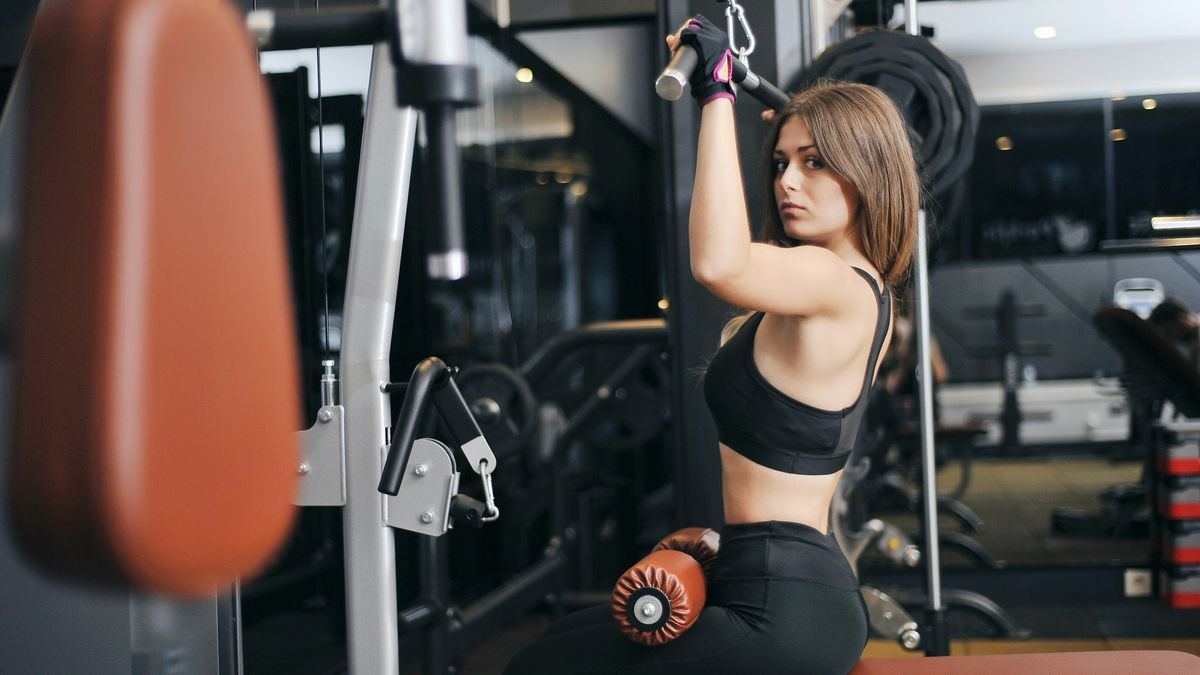
The number on a cable machine's weight stack is the weight of the plates in the stack, not always the resistance you feel at the handle. Depending on how the cable runs through the pulleys, you might be pulling the full stack weight (1:1), half of it (2:1) or even a quarter of it (4:1). That's why the same "50 lb" can feel completely different from one gym to another.
What pulley ratios mean
Pulleys can trade force for distance. When a cable is routed through a movable pulley, the machine lets you pull the cable twice as far while the stack rises only half as much, so you need only about half the force. Manufacturers use this to give cable machines a longer range of motion and lighter starting weights.
| Ratio | Resistance at the handle | Stack says 100 lb, you feel about | Where you'll find it |
|---|---|---|---|
| 1:1 | Full stack weight | 100 lb | Lat pulldowns, seated rows, many single-station machines |
| 2:1 | Half the stack weight | 50 lb | Most dual-cable crossover machines and functional trainers |
| 4:1 | A quarter of the stack weight | 25 lb | Some functional trainers built for fast, long-range movements |
On top of the ratio, friction in the pulleys and cables adds a little extra resistance, and older or poorly maintained machines can feel noticeably heavier than new ones.
How to tell which ratio your machine uses
- Read the stickers. Many machines print the ratio near the stack or on the frame, sometimes as "2:1" or as both the stack weight and the "effective" weight.
- Watch the stack. Pull the handle a set distance, for example 50 cm. If the stack moves the same distance, it's 1:1. If it moves half as far, it's 2:1. If it barely moves, it's probably 4:1.
- Look for a moving pulley. A pulley that travels up and down with the cable, rather than staying fixed to the frame, is the giveaway for a reduced ratio.
Why the numbers on cable machines aren't comparable
- Different ratios between machines, as above.
- Different stack increments. Some stacks go up in 5 lb steps, others in 10 or 15 lb, and some are labelled in kilograms or even plain numbers like "1 to 20".
- Different pulley heights and angles, which change how the resistance feels through the movement.
- Different friction from cable wear, pulley quality and maintenance.
Bottom line: cable numbers are a great way to compare you with you on one machine, and a terrible way to compare you with anyone else.
How to track progress on cables
- Note the machine. "Cable row, left side, gym A" sounds fussy, but it saves you from false plateaus when you switch stations.
- Log the stack number, not a converted weight. It's simpler and perfectly consistent.
- Use reps to progress when the next plate on the stack is a big jump. Add a rep or two before moving up, the same double progression we explain in our progressive overload guide.
- Use a small add-on weight if your gym has magnetic or pin-on plates, to make jumps smaller.
Are cables worse than free weights?
No. Cables are excellent for building muscle. They keep tension on the muscle through the whole movement, let you train at angles that are awkward with dumbbells, and are easy on the joints. Most good programs combine free weights for the big lifts with cables and machines for extra volume.
Frequently asked questions
Is cable weight real weight?
It's real resistance, but on machines with a 2:1 or 4:1 ratio you're lifting less than the number on the stack. On 1:1 machines it's close to the stack weight, plus a little friction.
Why is the cable machine at my new gym harder?
It probably has a different pulley ratio, more friction or bigger stack increments. Start a little lighter and rebuild from there.
Do lat pulldown machines use a 2:1 ratio?
Most standard lat pulldown stations are close to 1:1, but some designs differ. Check the stickers or watch how far the stack moves.
Sources
- Basic mechanics of pulley systems: a single movable pulley halves the force required while doubling the distance the cable travels (mechanical advantage of 2).
- American College of Sports Medicine (2009). Progression models in resistance training for healthy adults. Medicine & Science in Sports & Exercise, 41(3), 687–708.